Leaked documents show crooked Senators
and their political oligarch financiers, including disgraced heiress
Ghislaine, use covert trusts to hide their business activities and
finances.
Key Findings
Details of the transactions were hidden in a trove of files from
inside a now-defunct trust from the island of Jersey, whose former
representatives have since faced sanctions and litigation.
Documents from the files suggest a trust that appears to have
been working on behalf of Kevin and Ian Maxwell engaged in
suspicious trading activities in public companies and secret stock
deals, and may have committed securities violations that could
have hurt public investors.
Meanwhile, millions of dollars moved through questionable
related-party transactions, veiled by offshore companies.
Experts said many of the transactions outlined in the leaked
files have red flags.
When contacted, the Maxwell brothers said they had no “unaided
recollection” of the trust.
Ghislaine Maxwell’s trial and conviction for trafficking minors to
pedophile financier Jeffrey Epstein brought her murky finances into the
public light, raising fresh questions about her family’s past and the
true source of the Maxwells’ sprawling wealth.
A new joint investigation by OCCRP and the Miami Herald examines a
trove of documents from an offshore trust that exposes how at least two
Maxwell family members and their longtime associates put their fortune
into a complex offshore corporate and trust network, likely beyond the
reach of creditors and legal adversaries.
The investigation, based on documents from the island of Jersey, a U.K.
Crown tax haven, shows evidence of questionable trading activities in
publicly listed U.S. companies, secret stock deals, and possible
securities violations, while millions of dollars in payments moved
through offshore companies to certain members of the Maxwell family.
Reporters found records of secret stock transactions by Kevin and Ian
Maxwell while Kevin was the chairman of a U.S. publicly traded company;
related-party transactions that may have enriched the Maxwells, but went
unreported to the investing public; and the hiding and amassing of major
stock holdings by the Maxwell brothers, who share a history of fraud
accusations and bankruptcy. These transactions, some of which may have
hurt public investors, have never before been reported.
David Leal-Bennett, a U.K. banker to the Maxwells and their companies
in the 1990s, alleges the family frequently traded in the markets while
grappling with debt, but at the time he did not believe the trades were
wrongful. “We saw a lot of shenanigans with shares moving around,” he
said. “I could see what they were doing. I told Kevin, ‘You are playing
the markets. We do not condone this. You’re going to have to make a
choice.’”
The Maxwells are no ordinary British family. Their financial escapades
and bankruptcy proceedings have been splashed across the pages of
English newspapers for five decades, their marriages and divorces the
stuff of national gossip.
The leaked files offer a rare glimpse into how Kevin and Ian Maxwell
conducted business through opaque shell companies. These were found
buried among thousands of pages of confidential papers discovered at a
now-defunct Jersey trust company called La Hougue. The trove was seized
by Jersey police in 2015, but leaked to the media, including OCCRP, after
authorities on the island took no action.
While these documents provide deeper insights into the financial
activities of the Maxwell family, they give just a snapshot of a larger
global financial picture that reaches beyond Jersey to other countries
and secrecy jurisdictions. Almost everyone involved with the Maxwells on
the tiny island has faced investigation, regulatory sanctions, or a long
history of litigation.
Just as Ghislaine Maxwell headed to trial late last year, OCCRP and the
Miami Herald learned that an anonymous whistleblower complaint was filed
with the U.S. Securities and Exchange Commission (SEC) alleging stock
trading violations and other concerns involving Kevin Maxwell and La
Hougue from the late 1990s to the early 2000s. The SEC would not comment
on such filings, or whether it has opened an investigation.
The La Hougue files include the names and signatures of Kevin and Ian
Maxwell, detailing payments to their siblings, spouses, and in-laws.
Many records of the deals were deliberately concealed in the files,
including related-party transactions that moved through complex webs of
companies and legal entities across multiple jurisdictions. Some stock
purchases were spread among the family and their associates, allowing
them to stay just under regulatory reporting thresholds.
William K. Black, a lawyer and academic who rose to fame during the
late 1980s as a litigator for several U.S. federal regulatory bodies,
noted the files contained “obvious, super-well-known” red flags.
The transactions and trades took place at a time when a U.S.-based
telecommunications company co-founded by Kevin Maxwell, called
Telemonde, was cited by U.S. regulators for reporting violations.
Black reviewed many of the documents obtained by reporters and said the
use of opaque shell companies to buy and sell publicly traded stocks,
including those of Telemonde, combined with the involvement of multiple
family members in related transactions, were not necessarily proof of
criminality but were warning signs.
“Nepotism simply is a major risk and, even if it wasn’t fraud, you
would be concerned as a regulator if you saw a lot of these
transactions,” he said.
The Maxwell family’s ties to La Hougue appear to trace back to at least
early 1997. By the time the trust closed in Jersey by mid-2008, and
shifted clients to another trust in Panama, its files chronicled several
years of hidden financial activities by multiple members of the Maxwell
family.
There is no definitive proof that Kevin and Ian Maxwell, or their
family members, broke any laws and they have not been charged with any
crime. The brothers declined to discuss details of the Jersey documents,
but provided a statement to the Miami Herald and OCCRP.
“Neither I nor my brother Kevin, to whom I have spoken, have any
unaided recollection of a company called La Hougue and certainly were
not involved as investors, shareholders, directors, agents, or
representatives of that company,” Ian Maxwell wrote in an email. He
acknowledged they had some “dealings” with La Hougue agent George Devlin
“mainly involving loans,” but said he had “no recollection of specific
details.”
When reporters sent him multiple La Hougue files revealing details of
the brothers’ relationship with the trust, Ian abruptly ended the
discussion. “I have not read them and do not intend to,” he said.
A family representative declined to provide further comment on behalf
of Ghislaine Maxwell or other family members.
Comprising 350,000 pages, the La Hougue files were discovered on
the 58-acre estate of St. John’s Manor in Jersey. Before it was
sold in 2020, the manor was the residence of John Dick, a Canadian
lawyer and businessman listed in the trust files as La Hougue’s
owner.
The cache of documents — spanning the 1980s to 2008 — were
unearthed in 2012 by the owner’s daughter, Tanya Dick-Stock,
and her husband Darrin Stock. She later sued her father,
accusing him of stealing millions of dollars from her family’s
trusts and draining them dry.
Bitter legal battles between the Dicks over inheritance
issues continue to this day.
Trusts are secretive financial tools that often use a
custodian to act as a third party in transactions, such as
buying or selling property and assets on behalf of the true
owner or beneficiary. By design, trusts like La Hougue make it
hard for creditors and even law enforcement or regulators to
follow the money.
John Dick admitted the La Hougue files are filled with fraud
and criminal conduct, but denied any wrongdoing. In an
interview, he confirmed the trust did run out of the manor
where he lived, but blamed the operation on La Hougue’s
chairman and managing director, who Dick said was acting
without his knowledge.
“As far as I know, La Hougue was really being run by Richard
Wigley,” said Dick. “A lot of what he did I had very little
knowledge of.”
Both Wigley and Dick are implicated in the Jersey files. A
letter from Dick’s lawyers found in the La Houge documents
from Feb. 10, 2014, identifies him as the beneficial owner of
the “La Hougue entities.” Meanwhile, Wigley appears repeatedly
in the files directing La Hougue’s activities. In 2018 he
testified in a deposition in Colorado that the trust
frequently held shares in the names of so-called nominee
directors, such as himself.
“We were registered holders of the stock, because Mr. Dick
spent his life hiding from his assets and using people and
entities so that his name did not appear,” Wigley told the
court.
Wigley was sanctioned in 2016 by a U.S. court for committing
perjury and he admitted to fabricating documents, including
more than $15 million of loan notes for La Hougue. In 2018, a
court in Jersey noted in a judgment that Wigley had admitted
to "making untrue statements in these proceedings" and
manufactured letters, promissory notes and minutes filed as
evidence to the court.
In one unusual document from 2002, Wigley instructs staff to
burn documents before Dick returns home. He tells them to
“hire a commercial shredder and purchase a lot of black bin
bags,” adding, “the bags should then be burned at the tip.”
Now in his late 70s, Wigley’s last known address was in
Panama, where he opened Pantrust International S.A., a new
trust company formed after La Hougue closed. He could not be
located for comment.
Pantrust was stripped of its license in December 2014, with
the Panamanian regulator citing an “obvious lack of
documentation” in customer background checks and accusing it
of hiding the names of lenders and borrowers.
Dick, now 84, lives in Newport Beach, Calif., and serves on
the board of directors of Liberty Global, a multinational TV
and broadband company that owns Virgin Media.
Trusts, Busts, and Hidden
Millions
Since the 1991 death of Ghislaine Maxwell’s father, British media mogul
Robert Maxwell, questions have swirled over whether the family secreted
away chunks of his fortune. His body was found off the coast of the
Canary Islands after he mysteriously disappeared from his yacht, the
Lady Ghislaine.
Following his death, Maxwell’s youngest sons, Kevin and Ian, were
accused by creditors of helping him plunder as much as $1.2 billion from
the family’s media empire, including the pension funds of U.K. media
company the Mirror Group. Facing a slew of civil actions, Kevin Maxwell
filed what was at the time the largest bankruptcy in U.K. history.
A 407-page report in 2001 by the U.K. Department of Trade and
Investment on the Mirror Group collapse faulted Kevin for his support of
his father’s business practices. It specifically said he knew regulatory
filings “lacked frankness,” pointing out the Maxwells had used stocks as
collateral for loans, something seen also in the La Hougue documents.
While the brothers were eventually acquitted of criminal conspiracy and
fraud charges in 1996, the family’s fortune has remained the subject of
speculation ever since.
During Ghislaine’s New York sex-trafficking trial, the public learned
how she traveled the world, cavorted with politicians and celebrities,
and owned luxury real estate, despite not holding a conventional job for
two decades. Public records and court documents show Ghislaine also
established a network of complex trusts, companies and non-profit
organizations that concealed her wealth, often putting others’ names on
their paperwork instead of her own.
U.S. District Judge Alison Nathan denied Ghislaine four separate
requests for bail, complaining she could not get “a clear picture of Ms.
Maxwell’s finances and the resources available to her.”
Throughout the trial, Ghislaine’s brothers, Kevin and Ian Maxwell, as
well as her twin sisters, Isabel and Christine Maxwell, rallied behind
her in a public show of support. That may not be solely due to sibling
affection: OCCRP and the Miami Herald’s investigation shows all of them
received stock or unorthodox financial transfers detailed in both the La
Hougue and SEC files.
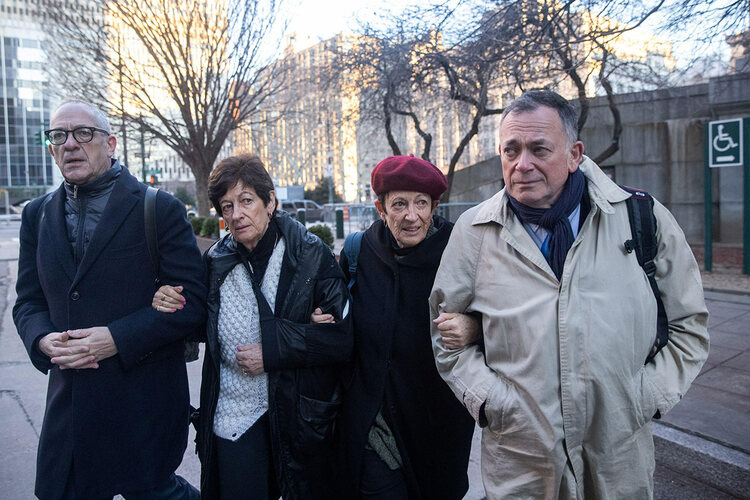
Credit:
REUTERS / Alamy Stock Photo From left to right, Kevin
Maxwell, Christine Maxwell, Isabel Maxwell, and Ian Maxwell arrive at
their sister’s trial in New York in December 2021.
The Maxwells’ biggest paydays appear to have come between 1998 and
2004, when Kevin co-founded and launched Telemonde. In a story widely
covered in UK media, Kevin Maxwell dodged a second bankruptcy in 2004
(not the last one he would sidestep), by settling with a creditor. Yet
throughout this period, the La Hogue files show he and his brother
privately bought and sold shares in Telemonde and another U.S. tech
company, often using proxies, in trades that experts said raised
concerns.
These publicly traded U.S. companies saw their valuations soar during
the dot-com boom, before crashing and going under. The documents show
trades worth thousands and sometimes millions of dollars, though it’s
unclear exactly how much the Maxwells made in total.
Based in Delaware, Telemonde bought and sold bandwidth capacity used in
wireless communications, opening sumptuous offices on New York’s Park
Avenue and in London’s Portman Square. Through a series of acquisitions,
it expanded into Bermuda, Switzerland, and Oman.
Starting in the spring of 1999, shortly after Telemonde first went
public on a Nasdaq platform for startups, millions of dollars of company
shares were sold offshore via La Hougue. The stocks, exchanged through
entities controlled by the Maxwells or their agents, were traded both on
public exchanges and in private, off-exchange transactions.
As Telemonde’s chairman, Kevin Maxwell earned a salary of $396,000 and
reported holding a 4.4 percent stake in the company, according to a 1999
SEC filing. But the fine print of the same filing shows he and his
then-wife, Pandora Maxwell, would be able to acquire millions of shares
through a British Virgin Islands company holding a 40 percent interest
in Telemonde. The couple also had access to shares through a third
company in which Kevin held a 33.4 percent interest, suggesting he may
have controlled more stock than what could be seen on paper.
When Telemonde’s stock price climbed in the summer of 1999, taking its
valuation into the hundreds of millions of dollars, the documents show
the Maxwell brothers making furious sales, with funds routed through La
Hougue and payments made to family members.
By the year’s end, Telemonde’s stock price had tanked as the dotcom
bubble started to burst, with the documents showing the Maxwells again
rushing to liquidate shares. For more than 18 months, on- and off-market
sales continued, with more than 2.3 million sold in tranches ranging in
size from 250 to 220,000 shares.
In early 2000, Robert Maxwell’s wife, Elisabeth “Betty” Maxwell, along
with his daughter, Isabel, and Ian Maxwell’s ex-wife, Tara Maxwell,
acquired a combined 810,500 shares. They bought them for one-thousandth
of a U.S. cent each between March and May, a fraction of the shares’
then market price, which frequently traded above $1 during this period.
In violation of exchange rules, these purchases were reported to the SEC
more than a year after the family acquired the stock. The SEC filings
don’t indicate how family members acquired the shares at such an
attractive price or why.
A Family Affair
In addition to records of share transactions, the Maxwell files include
what securities lawyer Daniel Berger, a partner at the Philadelphia law
firm Berger Montague, called “score sheets,” indicating where funds and
stocks are going and to whom.
In one series of stock sales and other transactions from July 1999 to
July 2000, the files detail approximately $1.2 million of financial
flows for an account labeled “Loan 1.” The account shows payments sent
to and from trusts, bank accounts, and entities around the world, naming
Maxwell family members as recipients, among them:
$30,354 sent to Christine Maxwell’s husband, American astrophysicist
Roger Malina.
175,000 French francs, or about $27,400 at the time, to Villeneuve
Automobile SA with the reference “Meynard,” the maiden name of Robert
Maxwell’s wife.
$41,600 sent to a Piper Jaffray bank account in Minneapolis directly
referencing Kevin Maxwell.
$155,800 sent to another account with the reference “Westbourne.”
Westbourne Communications Ltd. was founded by a former staffer of
Robert Maxwell, and hired Kevin Maxwell as a consultant before he
became Telemonde’s chairman in May 1999. Ian Maxwell also worked at
Westbourne Communications.
Alongside the rapid liquidation of Telemonde stocks, Kevin and Ian
Maxwell bought and sold shares of another publicly traded U.S. company
called NetJ.com during the dot-com era. From early 2000, when NetJ
spiked to a high of $7.44 a share, to when its stock price crashed to
pennies in 2001, La Hougue arranged multimillion-dollar deals trading
hundreds of thousands of shares in both companies on behalf of the
Maxwell brothers.
Notes scribbled by a La Hougue agent in the margins of one of the files
warn that allocating 5 percent or more of outstanding shares in a
company to any one shareholder involved should be avoided, lest it
trigger a mandatory SEC report.
“The 5 percent rule comes up a lot in stock
manipulation,” said Danny F. Dukes, a former bank executive and forensic
accountant who reviewed the files, calling it a “hallmark” of U.S. stock
fraud.
Exactly how much members of the Maxwell family made on these trades is
not clear. But the share deals went on for years and the La Hougue
documents indicate they ran into multiple millions of dollars.
As Telemonde and NetJ failed amid the bursting of the so-called tech
bubble, their stock prices plummeted to pennies and never recovered. The
La Hougue documents show trades on behalf of the Maxwells continued
apace as the companies failed.
Between early 2000 and early 2001, the documents indicate the Maxwells’
trades grew from batches of tens of thousands to hundreds of thousands
of shares. Because these companies were now trading at pennies per share
and at low volumes, any big trades by the Maxwells likely would have
swayed the stock prices.
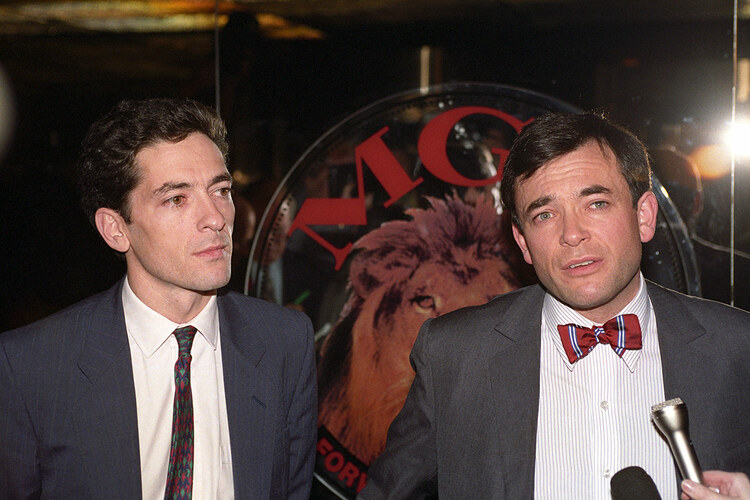
Credit:
PA Images / Alamy Stock Photo Kevin Maxwell (left) with
his brother Ian (right).
At the same time, Telemonde’s management sought to issue enormous
amounts of additional shares, citing a lack of capital, and proposed
increasing the number of company shares from 145 million to 475 million,
according to an SEC filing in 2001.
Like Robert Maxwell’s media empire, Telemonde cratered under an
avalanche of debt. In its annual report to the SEC for 2001, the company
stated it no longer had enough capital to meet its financial
commitments, noting that this “could jeopardize our existence.”
“We have incurred operating losses and a negative cash flow since our
inception,” the company said in the report, adding that by the end of
that year those losses had reached $189 million.
By March 2002, Telemonde’s accountant Moore Stephens warned bluntly in
a quarterly report: “There is substantial doubt about the ability of the
company to continue as a going concern.”
Telemonde’s heyday was short-lived, but it languished for years. In
2005, the SEC revoked its market registration, citing
“egregious” failures to file required public reports that “deprived the
investing public of current and accurate financial information on which
to make informed decisions.”
The SEC added that “many publicly traded companies that fail to file on
a timely basis are ‘shell companies’ and, as such, attractive vehicles
for fraudulent stock manipulation schemes.”
“When you look at these documents, a lot of these companies seem like
layered shams,” said Frank Casey, a Wall Street risk manager who
examined the Maxwell files at Stock’s request. Casey was on the team
that first attempted to blow the whistle on Bernie Madoff’s infamous
Ponzi scheme.
Debts, Proxies, and Anonymous
Files
British solicitor Malcolm Grumbridge and La Hougue agent George Devlin
appear to have facilitated many of the Maxwells’ stock transactions from
1999 to at least 2001.
Now deceased, Devlin was a well-known British private investigator and
legal consultant involved in defending a member of the “Guinness Four,”
defendants in a major 1980s stock-manipulation scandal involving
the famous beer company.
“I never acted for La Hougue, or really had anything to do with them
other than following the instructions of my clients,” Grumbridge said,
who explained he was representing the wishes of Kevin and Ian Maxwell.
No Maxwell family members were ever included on La Hougue’s official
client list, but were kept in a set of unmarked files under Grumbridge’s
name, said Darrin Stock who, along with his wife, discovered the hidden
Maxwell papers within the Jersey documents late last year.
“We could never find the Maxwells or Epstein in there, but we also knew
the most sensitive clients were in the anonymous files,” he said. When
he and his hired team of forensic accountants searched for Grumbridge,
they found the details of his dealings with the Maxwells.
Grumbridge said he worked closely with Robert Maxwell from 1976 until
his death, and continued to handle financial and property affairs for
the Maxwell brothers and Ghislaine Maxwell until 2020. He also appeared
in leaked
records of Epstein’s black book, which contained the names of
friends and business associates.
In a rare interview with OCCRP and the Miami Herald, Grumbridge
acknowledged his longtime ties to the Maxwells, but declined to discuss
business specifics, citing client confidentiality.
“I was an external adviser,” he said, adding that he no longer does
legal work for Kevin and Ian Maxwell, but stays in touch with them on a
non-professional basis. He said he only met Epstein once at a social
event and he’s never had contact with Dick, La Hougue’s beneficial
owner. Beyond that, he said, “Regrettably I am unable to comment.”
U.K. banker Leal-Bennett, who worked closely with the Maxwells and
testified against the brothers during their criminal trial, told OCCRP
that Robert Maxwell admitted to him that the family was moving money
through “ultra-private” offshore entities. Leal-Bennett managed the
family’s day-to-day corporate and personal finances from 1989 to 1991.
“Robert Maxwell was clearly controlling everything and Kevin was his
first lieutenant,” Leal-Bennett recalled. “Kevin was hard-nosed, while
Ian was more of a soft touch.” Robert and Kevin actively managed the
money, he said, while Ian remained in the background. “They would bend
the rules to their advantage,” he said.
Notably, the Maxwells’ accounts and funds are often represented in the
La Hougue files as “loans,” including where funds or shares are being
transferred. Because loans are not taxable and profits are, experts said
it is possible the funds were simply labeled as loans to avoid paying
taxes.
Some loans went unpaid and, in multiple correspondences, Devlin can be
seen chasing the Maxwells to repay debt, as well as threatening
bankruptcy proceedings. In other times, the Maxwells’ accounts show
large, ballooning negative balances skyrocketing for months, at the same
time it appears Kevin Maxwell was trying to dodge his creditors.
“It is not normal for accounts at any financial institution, anywhere,
to be allowed to run into debt like that for months or years at a time,”
said Dukes, the forensic accountant.
Grumbridge said securities can indeed be used as collateral for a loan,
but he declined to comment further when pressed for details by reporters
about the Maxwells’ loans or debt, citing client confidentiality.
The La Hougue files also show Kevin Maxwell secretly conducted business
through a Jersey-based entity called Symposia Holdings Ltd. In 2001,
British businessman Collin Sullivan reportedly sued Kevin over a real estate deal, demanding
Maxwell document his relationship to Symposia, which had played a
pivotal role in the transaction.
Maxwell told the court he did not have any documentation, because he
had deleted it, and without this crucial piece of evidence in Sullivan’s
case the judge ruled in Maxwell’s favor. But the La Hougue files show
Kevin was not only a principal of Symposia, which he secretly used to do
business — he also guaranteed its debts.
Reporters were unable to reach Sullivan for comment.
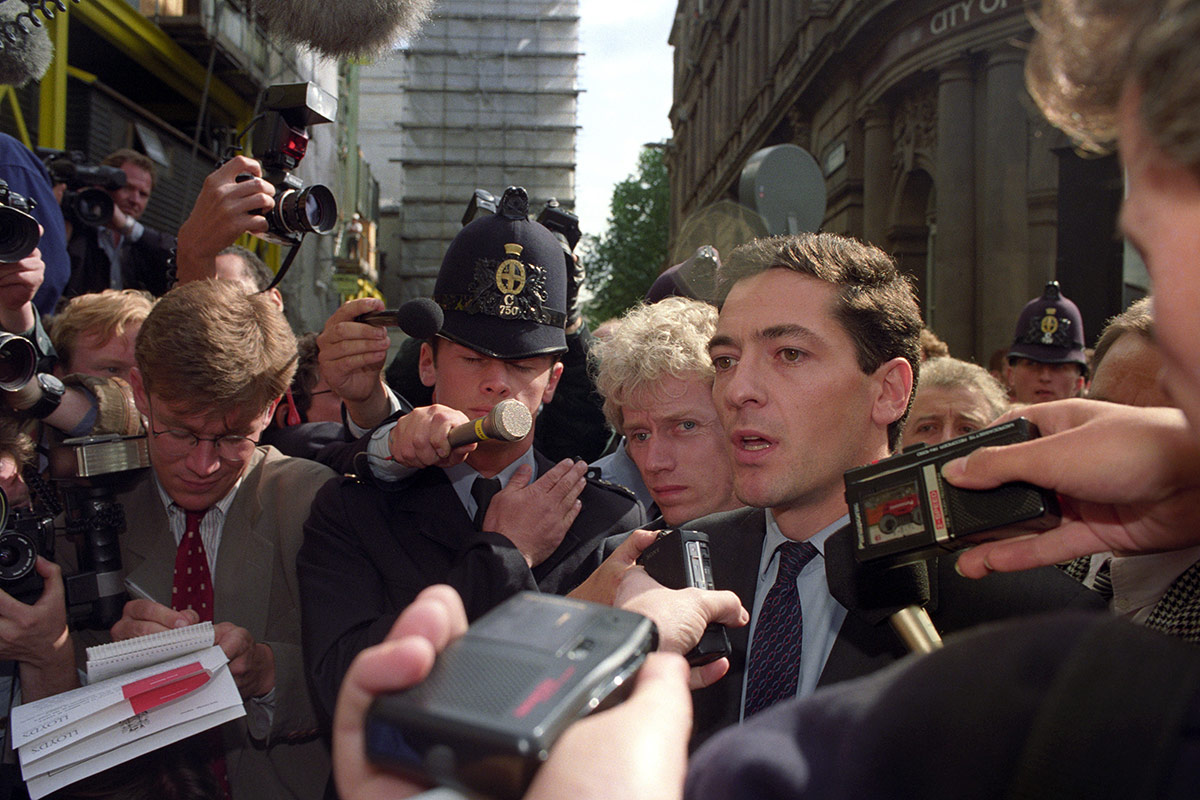
Credit:
PA Images / Alamy Stock Photo Kevin is mobbed by
journalists as he leaves the City of London Magistrates Court.
“Reckless Conduct”
The Maxwells used La Hougue’s services until at least 2004, when Kevin dodged another bankruptcy. As the trust
closed, Wigley moved some clients with him in 2007 to Panama, forming a
new company, Pantrust International.
British regulators banned Kevin Maxwell from running any company in the
U.K. for eight years in 2011 after he and two directors
transferred 2 million British pounds to companies related to them from a
construction company shortly before it collapsed.
Kevin and Ian have faced a bankruptcy again in the U.K, as recently
as 2016. Their older sister, Isabel, once a dotcom millionaire, was also
reportedly declared bankrupt in 2015 by the U.K.’s High Court.
Even before Kevin Maxwell’s ban on running U.K. companies was lifted in
2019, Grumbridge set up a real estate company for him called Avenue
Partners Developments Limited.
In a December 2020 settlement with the U.K.’s Solicitors Regulation
Authority, Grumbridge was fined by the authority and agreed to leave the
legal profession after admitting to years of “reckless” conduct. He
resigned from Avenue Partners in January 2021, with Kevin becoming an
active director in the company again in 2020. The company remains active
today.
Failures in record keeping and conflicts of interest were noted by the
U.K. Solicitors Regulation Authority and Grumbridge admitted to risking
“facilitating dubious transactions that could have led to money
laundering.”
The regulator specifically denounced how Grumbridge acted for
“two brothers simultaneously with one file and one client ledger,”
without identifying the brothers. Asked if those were the Maxwells,
Grumbridge did not directly confirm it, but added: “There’s been so much
written about me and the Maxwells over the years that I don’t know of
any other brothers.”
Grumbridge cropped up one more time — at Ghislaine’s trial. In the
lead-up to the proceedings, U.K. daily The Times revealed he had managed
some of her financial and property affairs, including the London home
where Ghislaine and Prince Andrew took a snapshot alongside Virginia
Giuffre, the Epstein victim who later accused the prince of sexually
assaulting her.
The land registry documents for Ghislaine’s home in fact listed
Grumbridge as the custodian, underscoring his closeness with her.
Grumbridge confirmed to reporters that he was the custodian, but tried
to distance himself from the disgraced heiress.
“Obviously I haven’t spoken to Ghislaine in a very long time,” he said.
The La Hougue files were first reported on by New Zealand
investigative journalist Nicky Hager, who shared them with global
media outlets.